| |
|
What caused the Civil War?
In Lincoln’s time, the mid-1800s, America was booming. Population and territory quadrupled, and the economy grew by seven times. In 1860 the value of the nation’s four million black slaves exceeded the combined value of all its railroads and factories. Lincoln’s 1860 election on an anti-slavery platform led to the formation of the Confederacy, splitting the nation. The CSA will fight to protect their states’ rights—including the right to own slaves.
 
The Confederacy believes that the US Constitution - not even 75 years old at this time - allows states to voluntarily leave the Union any time they wish. Southern states, whose economy is largely based on agriculture and the use of African-American slaves, fear the more industrialized north with an economy of free labor will destroy the southern way of life - by ending slavery. At the start of the War the value of the nation’s 4 million black slaves is worth more than the combined value of all railroads and factories in the country. The Confederacy views the war not as a fight over slavery. They are fighting for their rights - states' rights. Preservation of their liberty and freedom is the motivating factor to fight what they consider the Second American Revolution. Like the original 13 colonies, the Confederacy believes it is fighting for their independence against an illegal invasion of their land by the tyrant Lincoln’s Northern agressors. The tenacity with which Confederate soldiers fight underscores their belief in their rights.
Abraham Lincoln, faces the worst crisis in American history. He will do everything in his power to save the Union. He travels a long road from a poor log cabin to the White House. Lincoln is born in Kentucky in 1809, the son of a poor farmer. His earliest memory is cornplanting time in the Knob Creek valley where the Lincolns live. Little Abe, learning to work, walks behind his father, dropping seeds into the mounds made by his father’s crude hoe. Two seeds in every second hill, in every second row. Then came a great cloudburst, the water comes swirling down from the hills, washing away corn and topsoil. The fruit of their labor is lost. Almost half a century later Lincoln recounts: "I always thought that the man who made the corn should eat the corn."
This earliest notion grew into an intense and continually developing commitment to the ideal that all people should receive a full reward for their labors so that they have an opportunity to rise in life. This dream is as old as mankind, of the "city upon a hill," a light to the world, where all are endowed with the right to rise. This is Lincoln's American Dream.
As a young man on a riverboat trip he encounters a dozen slaves. Lincoln recounts, “They were chained six and six together. A small iron shackle was around the left wrist of each, and this fastened to the main chain so that the negroes were strung together precisely like fish upon a trot-line. In this condition they were being separated forever from the scenes of their childhood, their friends, their fathers and mothers, and brothers and sisters, and many of them, from their wives and children, and going into perpetual slavery.” Slavery is the opposite of the American Dream, the opposite of the central idea of the Republic. Slaves do not receive the fruit of their labor. A slave cannot rise in life.
In Lincoln's time America is young, growing and optimistic. The territory and the population of the US quadruples. The economy grows seven times. The country is booming. It seems nothing can halt American progress. Except one thing. Lincoln states : “All the armies of Europe, Asia and Africa combined, could not by force, take a drink from the Ohio, or make a track on the Blue Ridge, in a trial of a thousand years. If destruction be our lot, we must ourselves be its author and finisher. As a nation of freemen, we must live through all time or die by suicide.”
As the issues of slavery divides North and South, Lincoln rises to national prominence by opposing slavery: "A house divided against itself cannot stand. I believe this government cannot endure, permanently, half slave and half free. It will become all one thing or all the other.”
In 1860 he is elected President of the United States – spurring the secession of the Confederate States and the Civil War. Now the United States is on the verge of destroying itself. The Kings and Queens and Emperors and Sultans of the old world are watching the young American nation to see if this radical idea of “government of the people, by the people, for the people” can actually succeed. Lincoln knows if the Union loses the War the American Dream is lost. “We cannot escape history. The fiery trial through which we pass, will light us down, in honor or dishonor, to the latest generation. We know how to save the Union. In giving freedom to the slave, we assure freedom to the free. We shall nobly save, or meanly lose, the last best hope of earth.”
On January 1, 1863 he issues the Emancipation Proclamation – freeing all slaves in the Confederacy. The Union now fights to expand freedom to all people. It began with a poor boy's conviction that a man should receive the whole fruit of his labor so that he might get ahead in life: the right to rise from the log cabin to the White House. And Lincoln will do everything in his power to save the Dream. But here on these fields at Gettysburg - America and its Dream are on the verge of death by suicide.
|
How'd they shoot that? Learn more about our camera technology.
Aerial Cinema
To tell this story we are using an array of innovative technology including radio-controlled helicopters equipped with electronic gyro stabilization and mounted with high definition cameras. We worked with West Coast-based FreeFly Cinema, a pioneer in this rapidly evolving field, and Pennsylvania based Flying Media. We captured the battlefield in stunning clarity from never before seen vantage points. The high-resolution imagery captures battle sites from 400 feet in the air to inches above the ground. Aerial drones allowed us to follow the flow of battle over the exact ground men fought and died on 150 years ago.
We also shot gyro-stabilized footage with a full size Bell JetRanger helicopter and with a 5K Red Epic digital camera to capture the storied landscape in rich colors and unparalleled resolution.
Time-Lapse Cinema
Using technology at the vanguard of the industry for motion control time-lapse cinematography we are capturing the landscape in a new and dramatic fashion. To do this we shoot with state of the art full sensor DSLRs. We are also working with companies like Dynamic Perception and cinematographers that are spearheading this new art form, including Cameron Michael, Shawn Reeder and Jay Burlage. In fact, one of the very unique aspects of this project is that it marks the first time the National Park Service has permitted a film crew to shoot on the battlefield at night. The amazing low light capabilities of the latest cameras allow us to capture the ethereal beauty of the battlefield as billions of stars pass overheard. We are producing imagery, never seen before, from the soldiers’ perspective that transfixes the viewer.
|
Was Confederate General Lee America's greatest military mind?
General Lee comes down in history as perhaps the greatest military leader of his time - a mythic warrior hero
- nearly Godlike in the consciousness of the Confederacy. He comes to Gettysburg as the daring, dashing brilliant and unbeaten leader of the Confederacy's premiere army. A subordinate describes Lee at Gettysburg: "...he sat on his well-bred iron gray, Traveler, and looked across the fields eastward... He was fifty-six years old … a gentleman by blood and breeding, so truly that he was unmindful of it. He was...neat in his uniform of gray so careful of his dress... He wore a hat of gray felt, with medium brim and his boots fitted neatly, coming to his knee with a border of fair leather an inch wide...He was a kingly man whom all men who came into his presence expected to obey."
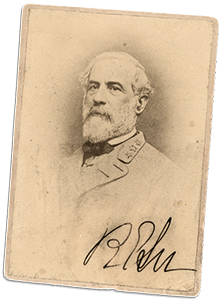
Lee's father Henry “Light Horse” Lee, a hero of the American Revolution, disgraced the family with gambling debts and bad investments, eventually abandoning the family when Lee was a boy.
Lee grows up with severely high expectations of himself - driving himself relentlessly to succeed. He graduates 2nd in his class from West Point and is selected for the elite engineering unit of the Army. He serves successfully in the United States Army for decades. When the Civil War breaks out President Lincoln offers Lee command of the Union army. After soul-searching Lee writes: "The struggle ...has cost me to separate myself from a service to which I have devoted all the best years of my life and all the ability I possessed...Save in the defense of my native State, I never desire again to draw my sword." His beloved Virginia estate will be taken by the U.S. and turned into Arlington National Cemetery for Union soldiers.
At the beginning of the War Lee is ridiculed by some Southerners. He is perceived as cautious and nicknamed "Ol' Granny Lee." But behind his grandfatherly features lies a fierce warrior. Lee craves the thrill of combat and does not shy away from bloody battles that kill thousands of men. He wants to punish his enemy. One Rebel commander says: “Lee is audacity personified. His name is audacity.” As Commander of the Army of Northern Virginia in 1862-63 Lee wins a series of impressive, daring victories against heavy odds. In barely a year Lee's men push the Federal army from the verge of besieging Richmond to defending their own land in the North.

In June, 1863 it seems noone can beat Robert E. Lee. In the most recent battle, Chancellorsville, in May, the Union army’s 130,000 men are defeated by Lee’s 60,000. Lee wins a great victory but loses his right-hand man, the great General Stonewall Jackson. Jackson dies after being wounded accidentally by his own men. Lee will now have to fight on without Stonewall Jackson.
Lee is confident in his army. "There never were such men in an army before. They will go anywhere and do anything if properly led," he says. But he knows the odds are against the Confederacy. The South has a much smaller population, far less industry, poor transportation and several Southern states—especially Virginia—have been devastated by two years of continuous fighting. The longer the war goes on, the better chance the North will have to win by simply wearing down the South. So Lee hatches a plan to end the war. He will take his army into northern territory—into Pennsylvania—both to relieve Virginia of the burden of the war and to destroy the Union army in its own territory. Then, he believes, foreign powers will recognize the Confederacy. The northerners will be so sick of war, they will pressure Lincoln to put an end to it. The Confederates will win the war and their independence. The Confederate government prepares an important letter offering peace. It will be placed on Abraham Lincoln's desk on the day after Lee destroys the Union army in Northern territory. While Lee marches his Confederate army into Pennsylvania, the Union command is in chaos.
However, Gettysburg is Lee's worst military performance. The great charge Lee orders on July 3 - the assault of 13,000 men under Pickett, Pettigrew, and Trimble agains the Union center on Cemetery Ridge is Lee's best known failure.
Many historians would argue that Lee's greatest mistake came on the evening of July 1, as his men were completing a route of the Union army. When the Rebel's Second Corps commander RichardEwell arrived on July 1, Lee ordered him to “carry the hill occupied by the enemy if you find it practicable” but to avoid a general engagement. Upon consideration, Ewell decided it was not “practicable.” His action—or lack of it—still excites controversy. What if he had taken Cemetery Hill? Or what if recently killed General Stonewall Jackson had still commanded the Second Corps? Critics have argued that he would have pursued the enemy, attacking while they were in disarray, defeating them, and perhaps ending the war here. But the Union position was stronger than Lee knew. With reinforcements pouring in, Ewell or Jackson would have found it difficult to take the hills. But Lee had also told Ewell to avoid a general engagement. And when Ewell asked for Third Corps support, A. P. Hill said his men were too exhausted. If Lee had felt that taking the hills on July 1 was crucial, he could have overruled Hill and ordered a coordinated attack. But apparently Lee believed his men could take the hills and whip the Yankees the next day, just as they had on July 1.
Gettysburg is the price the Confederacy paid for the brilliant generalship of Robert E. Lee.
What do you think? |
See more of Gettysburg National Military Park
See numeous still images of the beauty of the Gettysburg National Military Park.
Flickr Photo Set
Visit www.GettysburgFoundation.org for more on visiting the battlefield.
|
How did Abraham Lincoln's Gettysburg Address remake America?
Gettyburg is the greatest man-made disaster in American history. Pennsylvania's Governor visits the battlefield. He is appalled by what he sees here. Sights too shocking to describe: graves left open, bones scattered, bodies dug out and mutilated by dogs, hogs or wild animals. Skulls kicked around like footballs. Hell on earth.
This is the place where Abraham Lincoln must come and explain why this war must go on.
Lincoln is invited to come to Gettysburg to deliver "a few appropriate remarks." The dedication ceremony is set for November 19, 1863. Leading the country during war leaves the President almost no time to work on his remarks. It is likely not until three days before he is to deliver his speech that Lincoln, in the White House, finally begins to write. It is the first speech Lincoln writes before delivery in the 2 ½ years since his inauguration. He finishes the speech the next night in Gettyburg.
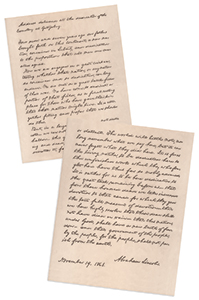
.
Lincoln must speak to the people. In less then a year he will be up for reelection – the only time in history a nation will hold a democratic election during a Civil War. If he loses it is likely the end of the United States. He begins to write:
''Four score and seven years ago our fathers brought forth upon this continent a new nation, conceived in Liberty,...'' Lincoln looks back to July 4, 1776 - the Revolutionary War, and reminds people that the birth of the nation had required great sacrifices.
''... dedicated to the proposition that all men are created equal.'' By quoting the Declaration of Independence, Lincoln presents a strong message about liberty without speaking of slavery outright. He does not want to alienate those who only wish to fight for the Union and not the ending of slavery. To most Americans "created equal" now means the right to rise in life. Lincoln wants to expand this right to rise– the American Dream – to all people.
Here at Gettysburg, the bloodiest American battle, in the bloodiest war of her history, surrounded by death, Lincoln must inspire the people to be ''dedicated to the great task remaining before us'' to win the war, to save their country to expand freedom to all to... ''highly resolve that these dead shall not have died in vain.''
Lincoln's writing reflects the oratory of the ancient Greeks and words memorized by generations of children learning about George Washington. And much of what Lincoln writes carries the sounds of the Bible. "That the nation shall, under God, have a new birth of freedom; and that government of the people, by the people, for the people, shall not perish from the earth." Birth, sacrificial death, rebirth. A born-again nation. At a less-than-conscious level, Lincoln weaves together the biblical story and the American story. His words reach the primeval longing for a new birth that humankind has yearned for through long, bleak winters and celebrated every spring since time began.
In November 1863 the Gettysburg Soldiers' National Cemetery is barren – a muddy field of freshly dug graves, almost no trees. Winter is nearing. The crowd covers this hill. The Ceremony begins with funeral music. The chaplain gives the invocation, praying for 8 minutes. Lincoln’s secretary says the reverend gives a prayer which thought it was a speech. There’s more music. Next is Edward Everett. He is the most famous orator of the time. He speaks without notes for two hours describing the battle and discussing civil wars of earlier nations that had ended in peace. He finishes and more music is played.
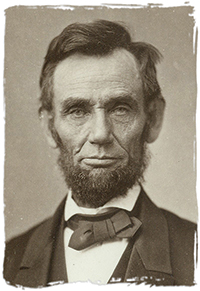
Lincoln gets up. A tall lanky man. Steps to the front of the platform. Born in near poverty in the frontier woods in a log cabin, his parents could not sign their names. And he, using words that today, still continue to urge us to keep freedom alive and ensure that all people have the right to rise, delivers his Gettysburg Address.
Four score and seven years ago our fathers brought forth on this continent a new nation, conceived in liberty, and dedicated to the proposition that all men are created equal.
Now we are engaged in a great civil war, testing whether that nation, or any nation, so conceived and so dedicated, can long endure. We are met on a great battle-field of that war. We have come to dedicate a portion of that field, as a final resting place for those who here gave their lives that that nation might live. It is altogether fitting and proper that we should do this.
But, in a larger sense, we can not dedicate...we can not consecrate...we can not hallow this ground. The brave men, living and dead, who struggled here, have consecrated it, far above our poor power to add or detract. The world will little note, nor long remember what we say here, but it can never forget what they did here. It is for us the living, rather, to be dedicated here to the unfinished work which they who fought here have thus far so nobly advanced. It is rather for us to be here dedicated to the great task remaining before us—that from these honored dead we take increased devotion to that cause for which they gave the last full measure of devotion—that we here highly resolve that these dead shall not have died in vain—that this nation, under God, shall have a new birth of freedom—and that government of the people, by the people, for the people, shall not perish from the earth. |
|
|
